-
What Does Courage Mean? Aung San Suu Kyi’s Courage
 Aung San Suu Kyi remains imprisoned in Myanmar. In January 2022 she was sentenced to four more years in prison for illegal possession and import of walie-talkies and breaking Covid-19 rules.Aung San Suu Kyi was arrested in February 2021 as the country’s military leaders staged a coup. Ms. Suu Kyi was detained for several years as she defied the military in favor of democratic rule, for which she won a Nobel Prize. She was recently re-elected as State Counselor (Prime Minister) in a landslide victory, which the army alleges was fraudulent (sound familiar?).Here’s the original article:In 1967, Kathrine Switzer entered the Boston Marathon as K.V. Switzer and ran the race as the first woman to run the Boston Marathon. In a famous photo from the NY Times, you can see an official (partly obscured behind her) trying to shove her off the track as her boyfriend gives him a body block, allowing her to continue and finish the race. (By the way, she ran the Boston Marathon again 50 years later in 2017, finishing only a little behind her original time.)Katherine’s feat took courage, in part because it was believed at the time that women were too “fragile” to compete in marathons. Every step of the way (literally), Katherine had to fight her fear and keep going.In these studies of Women Adventurers, thoughts of courage come up often, but I haven’t been sure what that means, so this concept is the study of this article. A spoiler: I don’t come to any earth-shattering conclusions about whether the individual actions of a specific woman are courageous; I’ll let you decide for yourself.
What is Courage?
The dictionary gives two meanings for courage:-
the ability to do something that frightens you, and
-
strength in the face of pain or grief.
Synonyms are bravery, fearlessness, daring, audacity, boldness, grit, hardihood, heroism. Two synonyms I don’t like because they refer to men are cojones or “balls.” (What’s the equivalent to “cojones” for a woman?).
Another definition says courage is, “the quality of mind or spirit that enables a person to face difficulty, danger, pain, etc., without fear.” I disagree about the fear part. Most people have fear – it’s part of our human emotional makeup. The courage comes from feeling the fear and doing it (whatever it is) anyway.
Nelson Mandela said,
I learned that courage was not the absence of fear, but the triumph over it. The brave man is not he who does not feel afraid, but he who conquers that fear.
And General George Patton, who certainly should know, said
Courage is fear holding on a minute longer.
Courage comes from the Old French for “heart,” and it relates to the belief that the heart is the seat of emotions. It might be that when we experience powerful emotions, adrenaline starts working, making the heart beat faster.
Like many other classical concepts, the term “courage” has been diminished by overuse. (I think of the word “tragedy” as another example. Falling off a roof and breaking your arm is not a tragedy. If 1000 people fell off a roof when it collapsed it might be.) There is certainly everyday courage, and many people have courage when they conquer their fears. It takes courage, for example, to get on an airplane if you have a fear of flying.
Courage, as I would like to use it in my writings, is the courage to an extreme degree, the courage to do heroic things that few others would do. Climbing the Himalayas or tramping through a jungle is courageous because the fears are huge and overcoming them takes something beyond mere daily courage. Extraordinary courage is also related to the historical and social context of these women. Traveling around the world on a ship isn’t terribly dangerous or rigorous today, but it certainly was in the 1700s, when Jeanne Baret traveled. She was the first woman to circumnavigate (travel around) around the globe.
When you read about the women in this Women Adventurers series, ask yourself if they have courage, and think about how that courage shows in what they do. What would you have done in their circumstance?
These women all wanted something so badly they had to:
- give up much of their lives, families, and connections,
- live on “the kindness of strangers,“
- face extreme perils (mountains, jungles, strange new lands, unsafe modes of travel)
- fight physical and mental limitations and the limits of increasing age,
- overcome the social restrictions of their time, and
- move forward constantly toward their goal.
If that isn’t extraordinary courage, I don’t know what is. Now, for a recent example:
Was Aung San Suu Kyi Courageous?
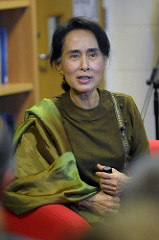
Photo by Simon Graham / Harrisons/via flickr Aung San Suu Kyi was State Counselor of Myanmar (formerly Burma). She is a world-renowned freedom fighter, was a political prisoner from 1988 to 2010, and in 1991 (while she was still under house arrest) she won a Nobel Peace Prize for her courage as a political dissident.
Born in 1945, she is the daughter of Aung San, who was central to the independence of Myanmar from Britain. After she graduated from the University of Delhi and Oxford, she held positions in the Myanmar government. In 1988, she participated in peace protests with a group trying to get a democratic government in the country. She was placed under house arrest in 1989 and was kept under arrest off and on until 2010 when she was released for the last time. At one point, she was granted her freedom if she would leave the country forever. She refused because of her loyalty to the independence of her country.
In granting her the Nobel Peace Prize, the committee said,
…Suu Kyi’s struggle is one of the most extraordinary examples of civil courage in Asia in recent decades. She has become an important symbol in the struggle against oppression…
What Happened to Suu Kyi?
In recent years, Suu Kyi’s reputation has taken a hit because of her stance on the continuing Rohingya refugee crisis. Briefly, almost 1 million Muslims lived in an area of western Myanmar called the Rakhine area. The primarily Buddhist country (and government) of Myanmar has denied the Rohingya citizenship and considers them to be illegal immigrants from Bangladesh.
Since violence in 2017, more than 670,000 of the Rohingya have been forcibly removed to Bangladesh and about one-third of their villages have been destroyed. The United Nations has called this a “classic example of ethnic cleansing” and says it’s the “fastest growing refugee crisis” in the world. And it still continues, though the Myanmar government has made some attempts to negotiate the return of some refugees.
The Myanmar government, of which Suu Kyi is the de facto head, has tried to downplay the crisis. Suu Kyi has said that “ethnic cleansing” is too strong a term for the situation. Meanwhile, some groups have withdrawn prizes and distinctions awarded to her, and some have called for her Nobel Peace Prize to be taken away. (FYI: According to the New York Times, the Nobel Committee has never and will never revoke a prize.)
Suu Kyi is a “devout Buddhist,” says Alan Cummings, in Aung San Suu Kyi: Voice of Hope, a series of conversations with this remarkable woman.
She may not have as much power as people think since the military seems to be in control. I can’t take away her courage in fighting for freedom.
If you want to learn about her in her own words,
here is a series of letters she wrote.
-

 She may not have as much power as people think since the military seems to be in control. I can’t take away her courage in fighting for freedom.
 here is a series of letters she wrote.
-
Subscribe
Subscribed
Have a WordPress.com account? Log in now.

