Ada Blackjack didn’t want to be a heroine; she just wanted to survive. But her courage and will to live is inspiring. Why was she cast as a hero? She survived two years on a desolate Arctic island, three months of that time alone with the body of a dead man and only a cat for company.
Ada’s Story – Before Her Journey
Ada was born in 1898 in an Inuit (native Canadian/Arctic people) community near Nome. She went to school in Nome and she missed all the traditional Inuit skills like hunting, trapping, and building a shelter.
She married Jack Blackjack, a violent man who gave her three children, but who beat her and the children. He finally left, stranding her and her surviving son Bennett. At age 21 she walked 40 miles to Nome carrying Bennett, who had tuberculosis.
Ada couldn’t make enough money to care for Bennett, so she had to put him in an orphanage. Then in 1921, she was approached by an Arctic explorer named Vilhjalmur Stefansson to go on an Arctic expedition as a seamstress and cook, promising her $50 a month, when she returned. This was a huge amount of money in Ada’s eyes, and though she was initially reluctant, she finally agreed to go on the expedition, expecting there would be other Inuit on the trip.
The Journey to Wrangel Island
Stefansson was a character of the highest order. He lied about many things, he was a con man, he exaggerated his adventures, and he was always after the glory, with little concern for others (especially a poor Inuit woman). He portrayed the Arctic as “friendly” and “hospitable.” (The men who survived the disastrous 1913 Karluk expedition, when he abandoned them, would surely have disagreed.)
The expedition Stefansson had planned was to Wrangel Island in the Arctic Ocean, just north of Russia. His idea was to send some men to claim the island for Britain and the U.S. (They weren’t interested and Russia, which actually owned the island, protested.) He didn’t plan to go himself (of course!), but he selected four men and Ada. And a cat named Victoria went with them.
The only time ships could travel through the Arctic was in July, August, and early September; there was too much danger of becoming ice-bound any other times. The four men and Ada left on September 9, 1921, planning to be at the island until the next summer.
They stayed a year on the island waiting for a ship to come the next summer. During that time, Ada became homesick and lonely, even though the men were kind to her. She started behaving strangely, sometimes working diligently and other times being sullen and silent. She developed an attachment to the commander, Allan Crawford, mooning over him and begging him to protect her from the polar bears that terrified her. Several times she ran away, and she tried to commit suicide by drinking liniment (a pain reliever). The men finally had to threaten her to get her to stop her craziness and get back to work.
If you think she was crazy, consider that she was alone on an island with four men strangers, during the cold dark Arctic winter. She was young and had lived in civilization, never in the wilderness, she missed her son, and she had no skills for survival.
When summer came, no boat showed up to take them off the island. They were running out of food, and one of the men (Knight) had scurvy. The other three men decided to take off to find help; they were never heard from again.
After Knight died in June 1923, she built a barricade of boxes around his body to keep animals away from it. She did what she could to find and shoot food and to protect herself from polar bears. She used driftwood spikes to strengthen the walls of the tent and she built a gun rack over her bed to be ready in case of an attack. She trapped white foxes, age seagull eggs, and shot what game she could find. Finally, on August 19, 1923, almost two years from the time they left for Wrangel Island, a ship came to rescue her…and the cat.
After Ada’s Arctic Adventure
Immediately after their return, the media circus began. She was accused of killing Knight, and there were questions about how she could have survived. Stefansson tried to avoid paying her but he eventually gave her the money he owed. He and the rescue ship’s captain, Noice, tried to exploit her story. She avoided the craziness and took her son to Seattle to get a cure for his tuberculosis. She and the Knight family connected and she talked to them about his last days.
Ada died in a retirement home in 1983, at age 85.
Jennifer Niven has written a good biography of Ada, including information from the diaries of some of the men and from Ada’s own diary. Reading it made me angry at the connivings of Stefansson and the way Ada was treated.
Was Ada Blackjack an Adventurer? A Heroine?
Although she was a reluctant traveler, she showed bravery by getting on the ship taking the explorers to Wrangel Island. She had no idea what would happen but she was willing to do it to help her son. Yes, she did have some problems on the island, but she settled down. She learned the skills she needed to survive, learning to shoot seals and other animals to survive. She built herself a shelf in the tent and slept with her rifle close, to protect herself from polar bears.
When she was left alone, she could have given up, but she didn’t. In her diary, she says, “I would never give up hope while I’m still alive.”
Imagine seeing Louse Arner Boyd on one of her polar expeditions – she would be dressed in typical Arctic gear, including boots, heavy sweater, oilskin jacket, and she could curse like a fisherman. But she would always put on makeup and powder her nose before going on deck. She might also be seen wearing a flower – usually a camellia. She even had a suitcase designed for her by Louis Vuitton.
Louise was a polar explorer in the 1920s through the 1940s. But she wasn’t a typical woman adventurer; she was wealthy and could afford to pay her own way (she often brought her maid on board). She might not have endured the rough conditions aboard the ships that other explorers might have had to suffer. But she still had to endure the dangers of the polar region and she had a tough time convincing men that she could explore with the best of them.
Louise’s First Polar Adventures
Louise Arner Boyd was born into a wealthy family in San Francisco in 1887; her father had made his fortune in gold mining. She was a tomboy, riding and shooting with her two older brothers. After the deaths of her parents in the early 1920s, she found running the family business boring, and she started to travel. Her first trips were conventional tours of Europe, but she had always found the Arctic fascinating.
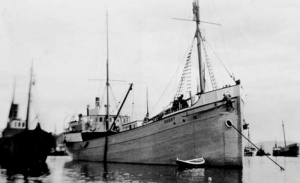
In 1924 she took a tourist ship to Spitzbergen, off the north coast of Norway. This trip was in part a polar bear hunting expedition, and Louise was a crack shot. She was thought to have bagged as many as 29 bears. Later, sensitive to criticism, she downplayed the shootings.
The Hobby – used for her explorations.
Her second voyage was important because it steered her in a different course in her adventures. As she began the trip in 1928, she learned of the disappearance of Roald Amundsen, a famous polar explorer. Amundsen and a pilot had taken off in a small plane to look for a dirigible expedition that had crashed. Louise immediately contacted the Norwegian authorities and put her ship to use to search for Amundsen. (He was never found.)
She was later awarded a medal by King Haakon VII of Norway, and she began to be taken more seriously by the scientific community and some (but not all) men scientists and explorers.
During the search, Louise worked with scientists and Arctic explorers on the ship and she discovered that she was interested in learning and documenting her trips rather than shooting polar bears. She began taking photographs and collecting botanical specimens. And she set out on her next expeditions with a more serious purpose – to chart the polar regions around western Greenland.
Dangers of Polar Exploration
Isfjord, Ilulissat, Diskobay, West Greenland. Edge of the Sermeq Kujalleq Glacier, one of largest Glacier Streams of the Greenland ice cap.
A quick note on the dangers of the Arctic; Like all adventures, exploring the polar regions of the Arctic Ocean have danger. The Arctic is a difficult place to travel in because of the cold and the shifting ice. The temperatures can be as much as -40 degrees Fahrenheit, and the window for traveling is small – only a few months in the summer. If ships wait too long to leave the Arctic, they can be blocked in by ice for the winter.
Louise’s Polar Expeditions
The preparation for an expedition takes many months and a good deal of money. Louise was a super-star at preparation. She spent her own money to buy the most up-to-date equipment and the best supplies. Everything down to the smallest detail was considered; you didn’t want to run out of something critical in the Arctic wilderness.
Louise’s third expedition in 1931 was primarily a photographic reconnaissance, in preparation for longer expeditions with more scientists aboard. This journey is the only one where she talks about meeting indigenous people. She liked and admired the Eskimos in Greenland, saying that they had “quiet, charming manners, … direct eyes, and their faces that …radiate kindness.”
On her first journeys, Louise had taken friends, but now she was dealing with the men of the scientific community. She had some difficulty getting scientists to join her, but she was persistent. On each voyage, she learned more, took more photos, documented more new fjords in Greenland, and endured new dangers.
In her 1938 season, she managed through sheer determination to go as close to the north pole as was possible at that time. The pack ice halted her ship only 800 miles from the pole, a new record.
Louise and the Scientists
As I did more reading about Louise Boyd in the biography by Joanna Kafarowski, I found out more about her relationships with the scientific community and the scientists who worked with her on her expeditions.
The scientists didn’t like Louise for several reasons:
She was a woman and she was their “boss,” running the expedition with an iron hand.
She wasn’t a scientist, not a member of the GOB (Good Old Boys) club of “real” scientists.
They were prima donnas, each wanting to be the star. But they were in the Arctic, and they had to listen to her for their own safety.
The scientists would huddle on the aft deck and mimic and mock Louise. It’s not clear if she understood what was going on; I hope not. When they were stuck on the ship, they blamed her instead of blaming the ice. After the expedition, some of them continued to belittle her, laughing at the way she gave presentations (she mispronounced “expedition” as “exposition”), her dress, and her voice.
But her botanical collections and scientific observations were precise and she used proper techniques. Her photos and charts of Greenland were valuable to the U.S. as intelligence sources during World War II.
She won the respect of the American Geographical Society, which sponsored several of her voyages and published her books. And she was
Louise’s Achievements
Her last polar expedition was in 1938; after that, World War II interfered and she was never able to go back. But she had achieved quite a lot. She was a recognized authority on the polar region, particularly Greenland, and she worked for the U.S. government during the war.
She was finally recognized by the American Polar Society for her contributions to the knowledge of Spitsbergen, Franz Joseph Land, East Greenland, and the Greenland Sea.
She wanted to get to the North Pole, so in 1955 (she was 67) she chartered a flight and flew over it. The end of her life was sad; she had spent all her money and she was in poor health. She died in 1972, just before her 85th birthday; her ashes were dropped in the Arctic Ocean.
I especially enjoy knowing that her name is on some Arctic landmarks – a fjord named “Miss Boyd Land,” the Louise Glacier and the Louise A Boyd Bank.
While she might not have endured some of the conditions of earlier women adventurers, Louise Boyd exemplified the persistent, courageous, and adventurous woman who succeeds.
_________________________
Disclosure: The books featured in my posts have links to Amazon.com, and I receive money if you buy a book from one of these links.
Dervla Murphy looked back on her life of adventure and travel and said that the key to travel is to “embrace the unpredictable.” Murphy certainly did that. She traveled through five continents, some of them with her daughter (when her daughter was 5!). She wrote 27 travel books, and she lived life as she wanted to, not bowing to the modern world.
Up to her death in May 2022, Dervla lived in the same town she grew up in, Lismore, in Co.Waterford, Ireland, and she had no smartphone or television. She played records (remember those?) and read for entertainment.
From an early age, she knew EXACTLY what she wanted to do. At age 10 she stated:
“I wanted to wander alone, taking each day as it came.”
For her 10th birthday, she received a bicycle as a gift and made a resolution to cycle to England. She later changed that resolution, saying she wanted to bicycle to India.
Wheels Within Wheels: The Making of a Traveler is the story of her life before her first bicycle journey. Dervla grew up an only child with an invalid mother and a father who was a librarian. She was in and out of school because she needed to care for her mother, who grew increasingly difficult and demanding as she grew older. Dervla’s loves were her books and her bicycle. In the home of her paternal grandparents, she found solace in the stacks of books. At 6 1/2 she had already decided
“the world was full of books and I intended to read as many as possible before I died.”
Finally, at 31, after the death of her parents, she was able to begin her first journey, traveling by bicycle from Ireland to India. (In case you were wondering how that would be possible, she started the cycling part of her journey from Dunkirk, in France.) The journey is recorded in Full Tilt, her first published book.
I loved this book! Dervla’s energy, her love of people, and her resiliency are contagious. She wasn’t afraid to meet people and make friends (although she did carry a pistol with her), staying with provincial governors and wealthy friends, but also the poorest of the poor, in their sometimes flea-ridden hovels, and once in a bed with several dirty children. She would eat the most ghastly, dirty, food with them. She started in January 1963 and traveled through Eastern Europe, Turkey, then Persia (Iran), Afghanistan, and Pakistan, ending up in Delhi, India in November.
Dervla’s bike, called Roz (after Rocinante, Don Quixote’s steed) had many problems. She seemed always to be dealing with punctures, brake problems, and various other issues. She took to leaving spare tires in strategic locations and having to wait hours or days for a ride. At one point a truck she was in broke down and she had to spend the night sleeping on tires waiting for help.
By Ryan Bodenstein [CC BY 3.0, via Wikimedia Commons, via Wikimedia CommonsMost of the time, she preferred riding, but she also took buses, and only occasionally a plane (she hated airplanes). She endured searing 110-degree heat and biting cold and snow, dysentery, theft, broken ribs, and many insect bites. I can’t imagine trying to ride a bicycle through the snow.
She did use her pistol twice. The first time she had to fight off some starving wolves in a dark Yugoslavian forest, one hanging off her shoulder and the other with a grip on her ankle. She admitted to being terrified but also thinking that the idea of being devoured by wolves was “faintly comical.” The second time she awoke to find an unwelcome male Kurd on top her. She fired into the air and he quickly left.
She traveled light, saying “the further you travel the less you find you need.” At one point, she was down to two pens, writing-paper, Blake’s poems (!), map, passport, nylon shirt,” with room for food.
Her attitude to everything was “what’s the fuss about?” For example, she said the Afghani people had no concept of time; a bus scheduled to leave at 8 a.m. might leave sometime in the afternoon. She said, “Personally I find all of this most endearing after a lifetime of being tyrannized by the clock.” When she lost some money, she commented that someone else must have needed it more than she did.
People and Places
Dervla had definite opinions about the people she met, but in general, she loved them – and they loved her too. The word would go out to a town that she was on the way, and she would find the local police waiting for her to help her find a place to stay.
She found most people accepted her, but many thought she was a man. She said
“…the idea of a woman traveling alone is so completely outside the experience and beyond the imagination of everyone that it’s universally assumed I’m a man. This convenient illusion is fostered by a very short haircut and a contour-obliterating shirt.”
She often stopped to admire the sights, after a long bike ride, for example. Here’s what she wrote about the Ghorband Valley in Afghanistan:
It was …” the most wonderful cycle ride of my life. Surely this must have been the Garden of Eden….High hills look down on paddy-fields and vivid patches of young wheat and net vineyards; orchards of apricot, peach, almond, apple and cherry trees smothered in blossom, and on woods of willows, ash, birch and sinjid [like a Russian or Persian olive], their new leaves shivering and glistening in wind and sun. “
“…At intervals there are breaks in the walls of sheer rock on either side and then one sees the more distant peaks of the Hindu Kush rising to 18,000 feet, their snows so brilliant that they are like Light itself, miraculously solidified and immobilized. …If I am murdered en route it will have been well worthwhile!”
More Journeys of Dervla Murphy
Places she traveled: Gaza, the Balkans, the Andes, Ethiopia, Madagascar, Nepal, Kenya, Transylvania, Israel and Palestine, Siberia, Bombay, far eastern Russia, Kenya, Zimbabwe, and Cuba.
One of her last trips was to Russia (Silverland: A Winter Journey Beyond the Urals) in her 70s and her last book was a family trip with her daughter and granddaughters to Cuba in 2009.
She broke away from travel writing to write two books about current events in England and Ireland. In 1975 She wrote Tales From Two Cities: Travel of Another Sort about conditions among immigrants in Bradford and Birmingham, in England. In 1979 she wrote A Place Apart: Ireland in the 1970s.
Reading about Dervla’s Adventures
If you want to read some of Dervla’s books, I suggest this order:
First, read Full Tilt about her famous first adventure. It’s enjoyable and gives you a sense of her exuberant love of life. Then go on to Tibetan Foothold, which continues her adventures working in a Tibetan refugee camp in the foothills of the Himalayas, meeting the Dalai Lama, and bicycling the Himalayas in late 1963. In between, or after, read Wheels within Wheels, her autobiography, to get a sense of who this marvelous woman is and why her story is so gripping.
A few years ago a video called “Who is Dervla Murphy“ was created. You can get it on Vimeo ($6 to rent). I’ll warn you that it’s difficult to understand her and there is no closed caption available, but I enjoyed seeing her and learning more about her life.
Tibet seems to fascinate many people. There is something about its mystery, the mountains, and the people that draws adventurers. It drew Sorrel Wilby, a photo-journalist from Australia, to it in the 1980s, when, at age 24 she walked 1900 miles in three and a half months from the border to Lhasa, the Forbidden City.
Sorrel had traveled about on bicycle through Japan, Korea, and China for several years, riding a bike up Mt. Fuji and along a stretch of the Great Wall of China near Beijing. She had come to Lhasa in 1984 from China, one of the first people to get a permit from the Chinese. One day while she was in Lhasa, she talked to a man who challenged her; “Now what do you want to do?” he said. “I want to walk across Tibet,” she replied. At the time, she didn’t know what she was getting into.
In 1985, with the help of some friends, especially Jigme from the Tibetan Sports Authority, and with funding from Australian Geographic, she began. She was loaded down with about 85 pounds worth of essentials (including a flute?). She decided to start in Kathmandu, a traditional jumping-off point for Tibetan travelers. There she took a training course in mountaineering, including “how to curse in Hindi dialect.” Her friend Jigme told her, “You will find what you are looking for.”
Before she left for her journey, she was able to meet the Dalai Lama. She walked up to him, and in typical Aussie fashion said, “G’day! You must be the great Dalai Lama!” She found him “warm and human” and they talked about yaks and her upcoming journey. Before she left he gave her pictures and other gifts, including a red protection cord, which he had blessed, to keep her safe.
Mount Kailash By Varun Bhoopalam – Own work, CC BY-SA 4.0
With little planning, she started her actual trek in August 1985 from Burang, in southwest Tibet near the border with Nepal. Naive and overly optimistic might be an understatement. She bought a donkey named Budget, who ran off from her the first day. So she jettisoned much of her essentials (keeping the flute) and she started walking. She quickly found out that it would have been good to break in her boots before she started. “No day would ever be as difficult as the first,” she declared. (That’s naive!) But she was entranced by the beauty of Mount Kailash, a sacred mountain for Buddhists.
After a few days of torture and pain, she made a decision.
“I had made this land my enemy,” she wrote. “If I kept believing this notion I would be waving a white surrender flag…within a week.” She decided she had to change herself if she was to accomplish what she wanted. “I wanted to eat, breathe, and feel Tibet – to experience the country and its people as deeply as I could.” She realized she had to challenge herself, “extending the boundaries of my own limitations and learning something new.” She pressed on.
She turned herself over to the experience, traveling from one nomad camp and remote village to another, depending on the kindness and generosity of the Tibetans. Even in August, winter was coming, and the days were cold. She joined a procession of pilgrims up Mount Kailash, chanting “Om Mani Padme Hum” (Bless the jewel in the lotus, a traditional Buddhist chant). At one nomad camp, she lost $800, which turned out to have been taken by a young Tibetan nomad man and his wife. She cried when the money was returned to her because they needed it more than she did.
When things got tough, she recited her mantra and found faith in a “new trinity – God, Buddha, myself.”
Tibetan Nomads By McKay Savage from London, UK – Tibet ’06 – 022 – Tibetan Nomads at Nam Tso, CC BY 2.0
As she walked, she grew stronger (and smelled stronger, too). She sent some of her belongings ahead of her a few days, and she walked with just a minimum, including her tent, depending on Tibetan nomads for food and shelter. She drank per-che, the Tibetan tea with rancid butter (see Alexandra David-Neel on this). She picked up the Tibetan language, becoming more confident in her conversational abilities.
She rarely stopped during the day. “…I usually found it difficult to stop for more than five minutes at a time. A restless energy fired my spirit until utter exhaustion extinguished its glow.” At one point, she walked 42 miles in 23 hours, because she couldn’t find a place to stop. A 1000-mile detour through the northern mountains in the early winter snows added many weeks to her journey.
One encounter with a man named Norbor who guided her for part of the way was particularly poignant. He was reluctant to leave his village to guide her, so she gave him a picture of the Dalai Lama. He had tears in his eyes and he couldn’t speak, staring at the photo (this was a typical reaction of Tibetans to being given the Dalai Lama’s photo). Then he told her his story: He had spent 17 years shackled in a Chinese prison because he refused to denounce the Dalai Lama. Others gave in to the Communists to lessen the punishments, but he refused, always having faith. “I wept as he told me his story,” she said. He also told her he had never until that moment known whether the Dalai Lama was alive.
The last part of her trek through the mountains was the most difficult; she encountered blizzards, blistered cheeks, split lips, and then snow blindness. She and her companions had spent three days walking in a circle!
She came out of the mountains and her trek changed; she found herself challenged by the landscape and emotional instability, probably due to starvation and the effects of the journey. Sadly, as she came close to Lhasa, she found out that Jigme, whose encouragement she had been using to prop her up, had been killed in a road accident a few weeks before. She lost heart then and almost didn’t complete her journey. She said, “I didn’t want to go to Lhasa. I wanted to go home.”
But her indomitable spirit carried her through. Just before she reached Lhasa, she came to a beautiful lake. “It was going to be a day where I loved Tibet more than anything or anyone or any place in the world.”
What Sorrell Wilby Learned
Through her journey, Sorrell learned a lot about herself, including her ability to do what she said she would. She gained some spiritual maturity, using her red protection cord and her mantra to carry her through. She also said, “I loved Tibet but I knew it really wasn’t my home. I was merely passing through. A silent observer- a one-time participant.” I think she was more than that; her writing showed that she loved the Tibetan people, and she learned to trust them and enjoy them for what they were.
She carried with her some memories. One is a day when she left a village that had been taken over by the Chinese. On her way out of town, a little girl tugged on her overall, game her some sweets, and whispered, “Say hello to the Dalai Lama for me.”
After Sorrell’s Journey
Sorrell has continued trekking, now with her husband Chris. In 1991 they traveled 4000 miles across Asia, and in 2011 when she turned 50 she trekked through Arunachal Pradesh, a closed tribal state of India. In 2016 Sorrel and Chris did a 20-day trip across the high passes of Everest.
***************
Disclosure: The books featured in my posts have links to Amazon.com, and I receive money if you buy a book from one of these links.
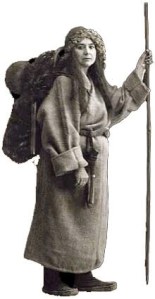
If you wanted Alexandra David-Neel to do something, all you had to do was tell her she couldn’t do it. At 5 years old, she ran away from home, scratched a policeman who tried to catch her, and showed no remorse when collected by her father. She was traveling alone in Europe at 17 and she lived independently from that time.
Alexandra’s biggest adventure was traveling incognito to the Forbidden City of Lhasa, Tibet at a time when no outsiders were allowed. When she was stopped at the border a few years before her trip, she said,
“It was then that the idea of visiting Lhasa really became implanted in my mind…I took an oath that in spite of all obstacles I would reach Lhasa and show what the will of a woman could achieve.”
Alexandra’s story and her journey through Tibet captured my attention. There’s something of a rebel in all of us, and we are attracted to people who dare to do what seems to be impossible.
Before Her Journey
Alexandra David was born in 1868 in Paris, an only child – a spoiled brat, which she admits. Her parents were conventional and, as noted above, she was rebellious from an early age. She became interested in Buddhism, an interest that turned into a life-long study. Her interest also focused on Asia, and she spent many hours as a young woman finding teachers and visiting an Asian art museum in Paris.
She didn’t want a traditional career or marriage because she didn’t want to be limited by anything (luckily she inherited some money and she financed trips with her writing). She began traveling to Asia when she toured as a singer and she fell in love with India.
In 1904, she married Philip Neel, who was about 10 years older than she and who let her do pretty much what she wanted. When she was 43, in 1911 she set out on a trip to India and Asia; she wouldn’t return for 14 years! She kept writing to her husband, asking him to send money and putting off her return (World War I was a good excuse to stay in Asia). She had done some writing for magazines and she wanted to travel and write about her experiences.
As she traveled through India she came to the attention of the British, who thought she was a French agent. She met the Dalai Lama (the 13th, not the current one), who encouraged her to “learn the Tibetan language,” and she studied Buddhism.
While in Sikkim (near Tibet, now a part of India) she traveled in the Himalayas and studied with a hermit, sleeping in tents, cooking over a yak dung fire. She said she found that living a life reduced to the essentials pleased her. But she also had a servant with her on her trips, and she took a zinc bathtub everywhere, insisting on a hot bath every night. Oh, well, I guess we are all full of contradictions.
When she wasn’t traveling, she became depressed and fatigued and she complained of feeling old.
Alexandra’s Journey to Tibet
Tibet had held her attention for many years, as the center of Buddhist thought and worship, and, as I noted above, because it was forbidden. In 1917, with a young lama (Buddhist holy man) named Aphur Yongden, whom she adopted, she headed for China on what would be a multi-year circuitous journey to Lhasa, Tibet’s capital.
She stayed for several years at a Buddhist monastery called Kumbum, which may have been the place that inspired James Hilton to write Lost Horizon.
Finally, in late 1923, she was at the border of Tibet. Alexandra and Yongden had “disappeared,” telling no one what they were doing and where they were going. They took nothing, not even a blanket, and she didn’t dare take a camera, but she did hide a compass, a pistol, and some money in her Tibetan peasant dress. She had left her zinc tub behind a long time ago. She died her hair black and wore a wig of yak hair (it must have smelled awful) to look more like a Tibetan beggar traveling with a lama (Yongden).
They begged for food and Yongden told fortunes and gave blessings for money. At the beginning of their journey, they stayed outside of towns, traveling at night and sleeping under bushes during the day. During the crossing of one pass in the Himalayas, they spent a night on a ledge in the snow.
Nearing Lhasa they decided to move faster so they began taking the risk of entering villages. She says they had many adventures and “humorous” stories of almost being recognized and captured.
Finally, on the first day of the Tibetan New Year, in 1924, they entered Lhasa. Alexandra was 56. They spent several months in Lhasa seeing the sights and avoiding being captured. Then they headed back to India and eventually back home to France.
My Journey to Lhasa: The Story of the Adventure
If you enjoy travel and adventure, you won’t find much better than My Journey to Tibet. With typical self-promotion, she subtitled it The Classic Story of the Only Western Woman Who Succeeded in Entering the Forbidden City.
She keeps her cool in all situations, even when they are in danger. One typical dangerous event is about a time when they were hiding under the snow. Some men passed by and one asked, “Is that snow or men?” “It’s snow,” the others answered. “It is snow,” Yongden said, crawling out. The men laughed and they talked, recognizing him as a lama, and they left. She knew he wasn’t in too much danger, but she might have been, so she was glad to avoid being discovered.
She says of the dangers, with her dry humor,
“People whose hearts are not strong and who cannot sufficiently master their nerves are wiser to avoid journeys of this kind. Such things might easily bring on heart failure or madness.”
In the midst of her perils, she finds moments of joy and beauty. For example,
“In this country autumn has the youthful charm of spring….It was one of those mornings when Nature bewitches us with her deceitful magic, then one sinks deep into the bliss of sensation and the joy of living.”
After Her Trip to Tibet
Alexandra finally went home, meeting her husband again after all those years. It was a big let-down for both of them, and they separated, staying married and “just friends.” She was in big demand as a speaker and she wrote books about her Tibet journey and other journeys and traveled around doing public speaking. She found luxurious hotel rooms uncomfortable and she usually ended up sleeping on the floor in her room (or in a tent in the hotel lobby!).
The incognito trip to Tibet caused quite a stir among Tibetan and British circles. There was some skepticism about whether she had actually made the trip. One author claimed she had invented the whole thing. A photo taken of her in front of the Potala (the Dalai Lama’s palace) in Lhasa was supposed to be a fake. But the truth of her trip has since been verified.
She went back to China in 1937 when she was 69. When the Japanese threatened to invade, she escaped. Her husband Philippe died during this time; she had to wait until after the war to return.
Alexandra bought a home in Digne-Les- Bains in southeast France, called Samten Dzong, “house of meditation.” The house is still open as a museum; you might want to visit if you are in the area.
At 100, ever the optimist, she renewed her passport. She died at 101, in 1969.
Why Alexandra David-Neel is Important
What a dame! She knew what she wanted from the beginning of her life, and she lived it – all of it – full out. You might not agree with her religious beliefs, and I’m sure she had her quirks, but she went where she wanted to go, she wrote about it, she did what she loved, and she didn’t have to die to be recognized. (After her death they named a street in a Paris suburb after her).
As I mentioned, she was not perfect. She loved Yongden, but she still treated him like a servant. She enjoyed meeting people, but she was mostly attracted to intellectuals and men of high rank and power.
Sure, she was frightened. She came very close to death multiple times on her trek to Lhasa, from starvation, cold, or being executed for being in Lhasa. She suffered from depression and had many illnesses while she traveled. I read about many other times on her journeys when she could have given up and gone home, but her almost-obsessive need to keep moving, to travel, to live free, kept her going.
____________________
Disclosure: The books featured in my posts have links to Amazon.com, and I receive money if you buy a book from one of these links.
Many women adventurers had it said about them that “she should have been born a boy,” but probably no more so than Annie Smith Peck. Just look at her; she scandalized the socialites in Rhode Island with her climbing attire. Here she models her outfit: wool tunic, knickerbockers (those baggy trousers), puttees (basically support hose), and a felt hat tied with a veil, as she leans on an ice pick.
Everything about her was anti-establishment. Born in 1850, she grew up in a wealthy family but she was always a disappointment because she didn’t conform to their expectations of womanhood. She went to college over the objections of her father and rejection of the dean of Brown University, who said, “Women are not encouraged to seek higher education.” She flaunted her singleness, calling herself “Miss Annie Peck.”
Like other women of her time, when she finished college she was expected to teach school, but she chafed at the restrictions and got a master’s degree in ancient studies in 1881. Then she studied in Germany, toured Italy looking for antiquities and lectured on Greek and Roman art. Her early trips were made without the help of her wealthy parents, who considered her a “hopeless case.”
Then Annie met the passion of her life – the Matterhorn. While in Europe teaching, she started climbing and was “fired with a determination to see this wonderful rock pyramid.” After climbing part way up she was hooked, and she spent the rest of life climbing. She said,
“My allegiance previously given to the sea, was transferred for all time to the mountains, the Matterhorn securing the first place in my affections.”
She climbed smaller mountains for practice then climbed the Matterhorn in 1895 at the age of 45. Then she started looking for more challenges.
Challenges of High Elevation Climbing
Before I talk about Annie’s climbing adventures, I want to tell you about the dangers and challenges, to give you an idea of what climbers face:
Altitude. The climbs she made in South America were at elevations around 20,000 feet. The atmosphere up there is only two-fifths at sea level, meaning the oxygen is very thin. Climbers are subject to s0roche – altitude sickness – which presents like seasickness and can be fatal at that altitude. Exertion increases the risk and the heart is overworked. This means burdens have to be lighter and care must be taken. Annie tried taking oxygen with her but oxygen tanks are heavy, canceling out the benefit.
Cold. Fires burn lower in the scarce atmosphere, so it’s more difficult to stay warm and to cook food. Annie feared frozen feet more than anything, and she swore by her expensive boots. Food had to be easily prepared and digested. Chocolate and brandy were essential.
Rough terrain. Climbing snow and ice covered mountains is terribly dangerous. Annie said the trek up the Matterhorn had dangers “where one’s neck may be broken in a variety of ways.”
Climbing in South America
Mt. Huascaran By Ondando – Own work, CC BY-SA 4.0, Wikimedia Commons
After some further climbing adventures and training, Miss Annie Peck set out to conquer mountains in South America. She was looking for a “virgin peak” where no man had previously climbed. She first tried Mt. Sorata in Bolivia, but she fell short in her attempt by 367 feet. Then she decided on Mount Huascaran, the highest peak in Peru.
Annie’s biggest problem on these climbs was finding reliable people to go with her. She wanted a “white man” on the trips because she was worried about being alone with the native men. But it turned out she was an optimist and a poor judge of people. All the men she hired were either cowardly, soft, or unreliable. She couldn’t rely on the locals who had never lived or worked at the highest altitudes. On her later attempts, she ended up hiring Swiss mountaineers to help her.
On her first attempt at Huascaran she found a soldier of fortune to help her, but he was “faint-hearted,” in her words. She contemptuously commented, “There was not the slightest danger.”
Mt Huascaran proved to be an almost impossible task. It took her six attempts to finally get to the top. She believed the peak was at 24,000 feet and that she had broken a world’s record. Then she described a most terrible descent during which she worried about surviving. She was 60!
After Her Big Climbing Achievement
When she returned, her achievements were disputed by other climbers. One of them, Fanny Bullock Workman (you will read about her in another post later) spent $13,000 refuting Annie’s claims. Annie commented that she could have used that money!
Annie continued to climb but at lower altitudes. In 1929/30 she flew over South America, the longest air journey by a North American traveler at the time. In her 80s, she was still climbing. She also became an ardent suffragist. She died in 1935 at age 84, while traveling to Greece.
You can read more about Annie in this biography, “A Woman’s Place is at the Top.” I found much of my information about her here and in her account of climbing Mt. Huascaran, Uncommon Glory.
Why Annie Smith Peck is Important
I loved Annie’s persistence and her refusal to adhere to the norms of women at the time. She was a great adventurer and she accomplished much, in spite of her shortcomings. George Mallory, a famous climber, on asked by he climbed Mt. Everest, answered, “Because it was there.” Annie had the same kind of zeal for climbing.
As a woman, Annie was held to a different standard. Negative comments about her said, “She drove her men relentlessly,” she was “ambitious,” and “impatient.” Couldn’t the same thing be said of men explorers? Yes, she was ambitious. She wanted to be famous. All through her life, she kept all her correspondence from others and she demanded that others return her correspondence. She worked hard to get the money for her trips, and she was fiercely competitive.
Amelia Earhart said of her, “Miss Peck would make anyone appear soft.” Amen.
________________________
Disclosure: The books featured in my posts have links to Amazon.com, and I receive money if you buy a book from one of these links.
In August 1931, three half-caste girls escaped from Moore River Native Settlement south of Perth, Australia, and walked almost 1000 miles in 9 weeks to get to their homes. In March (2018) the last of these girls, Daisy Kadibil, died at age 95.
I was so moved by Daisy’s obituary in the New York Times that I wanted to find out more. If this story sounds familiar, as it did to me, you might have seen the 2002 Australian movie Rabbit-Foot Fence, which chronicled their journey. I got the book and read it because I don’t trust movie versions of real events.
Follow the Rabbit-Foot Fence was written in 1996 by Doris Pilkington (her Aborigine name is Nugi Garimara), the daughter of Daisy, one of the girls. Much of what I’ll tell you I learned from this book.
Before the Escape
The British, then the white Australian settlers, took Australia from indigenous people, settling on their land, driving them out, creating fences to stop them from hunting, and giving them blankets (sound familiar?). Rabbit-proof fences were run through northwest Australia to keep the rabbits contained (it didn’t work.)
The settlers wanted to “keep up their Englishness,” and they set about working to “protect” the Aborigines from who-knows-what. They even set up a colonial Protector of Aborigines person. When Aborigines and Whites began intermarrying, the Australian government stepped in and decided to take these half-caste children away from their families. The girls were to be trained as domestics.
The three girls in this account were half-caste (Aborigine mothers and White fathers). Molly, the oldest, was 14, Daisy was about 8 and Gracie was 10 when their journey began. They were sisters, maybe cousins (it’s not clear which). All three were taken from their families in Jigalong, in northwest Australia and sent to Moore River Native Settlement.
When they got to the settlement, they found it a horrible place, like something out of Dickens, with padlocks on doors, bars on windows, watery stew, and “weevily porridge.” There were no sheets on the beds except for when visitors came. A concrete building with little light and no electricity was used for punishments.
The Escape
Rabbit-foot fence map with route / Author: Roke~commonswiki/on Wikimedia Commons
The second day Molly decided they were not going to stay, and she, Daisy, and Gracie walked out in the morning. Molly had learned some bush skills, and she led them across a river and into the country beyond. Her father was an inspector on the rabbit-proof fence line, and he had told her if she was ever lost to follow it. All they had to do was find the fence.
They walked through rain, spent cold nights under bushes or in rabbit burrows, and avoided capture by not going into towns. They did stop at farmhouses and were given some food and they caught rabbits and birds when they could. They were also given a box of matches to start fires to keep warm and cook their food, but they were often afraid to light it.
Meanwhile, the authorities were looking for them all the way. One press release claimed that the girls had left because they were new and scared (no kidding!) and “We have been very anxious that no harm may come to them in the bush.” (Since they had grown up in the bush, that sounds pretty lame to me.)
The girls doubled back, took circuitous routes, and generally outsmarted the searches. It’s strange that no one thought to give a reward for their capture, because they did interact with people who could have stopped them.
Molly pushed them all the way, reminding them to be brave and overcome their fears. They had to travel through rough terrain and prickly bushes, which gave them scratches on their legs. The scratches became infected and they had difficulty walking, so they took turns carrying each other (except for Molly who was heavier than the other two girls).
The girls were in constant danger of being captured or starving to death, but they somehow managed to continue. Finally, they found the north-south fence and started to follow it, but now they were in more danger because the authorities knew where to look for them and where they were headed. By early September, the police were increasing their efforts to find the girls, but they still remained free.
On the run for almost six weeks, Gracie finally had enough. She went into a town and learned that her mother was supposedly in a town south of where they were headed. She flatly refused to continue, and she headed out on her own. Molly and Daisy continued, sleeping and eating little and moving as quickly as possible. After nine weeks of travel, they walked into Jigalong.
Immediately, their families took them deep into the bush, not wanting to have them caught and returned. Many years later, Molly said, “Long way, alright.” It certainly was; Doris says their journey was “one of the longest walks in the history of the Australian outback.”
After They Returned From Their Journey
Doris’s story includes information about what happened to Molly, Daisy, and Gracie after they returned and I can update to the present:
Molly trained as domestic help. She married Tob Kelly and had daughters Doris (the author) and Annabelle. In November of 1940, she was transported again to Moore River. She escaped, taking Annabelle with her but leaving Doris at the settlement “to fend for herself with the help of a relative.” Three months later Annabelle was taken from her. Molly never reunited with Annabelle, but she was reunited with Doris 20 years later. She died in 2004. Did you catch that? She was taken from her family TWICE, once after she was married.
Gracie also was taken back to Moore Rivers, worked as a domestic, married Harry Cross and had six children. She died in July 1983.
Daisy trained as a housemaid (do you see a pattern here?), married and had four children. Her grandson said she was a “wonderful storyteller.”
Why are These Girls Important?
I love their courage, especially Molly, who drove them every step of the way when Daisy and Gracie got tired, hungry, and cold. Three young girls, out in the wild, outfoxing a bunch of white men for nine weeks!
“Apology to the stolen generation” by Martin Dougiamas is licensed under CC BY 2.0
It may seem that their journey was a useless effort since they were recaptured. But their story, and the stories of others like them, helped turn Australian public opinion around. I found out that Daisy later in life was active on the Sorry Day Committee, so of course, I had to look it up. Sorry Day, which just celebrated its 20th anniversary in 2018, is “the day on which Australians express regret for the historical mistreatment of Aboriginal people.”
One part of Sorry Day is the Stolen Generations project. Their website says,
“Between 1910-1970, many Indigenous children were forcibly removed from their families as a result of various government policies.”
The Stolen Generations project helps non-Indigenous people to learn the stories of these indigenous people and to “imagine new ways to live together more respectfully.”
___________________________________________
(If you would like more information on why the indigenous children were removed from their parents, I found two articles (here) and (here). It’s tough reading.)
Women in the 1700s didn’t work, they weren’t scientists, and they didn’t travel alone. Maria Sibylla Merian broke through all these barriers, creating a career for herself by combining art and science in a whole new way. Her drive to know sent her (at age 52!) to South America to study in the rainforest. Her life would be extraordinary if she were living today, but it’s even more so in that world.
This article is about Maria’s life and travels, as a woman adventurer.
Maria’s Life and Work
Born in 1647 in Frankfort, Germany, Maria was curious about the natural world from a very early age. When she was three years old, she began to study bugs and plants. She would bring home chrysalises and watch until they turned into butterflies. By the time she was 13, she was raising silkworms and other insects. She began to roam the countryside near her home to search for insects, and she recorded their behaviors, the timing of their metamorphosis and the plants they lived with.
Early caterpillar sketches
Soon she was creating illustrations, which were printed at her step-father’s printing company. She began to correspond with some of the scientists of her day, and she came to be known for her illustrations, like those to the right. Note the detail on these sketches. Her first works, two books of caterpillar prints, were published when she was 32 and 36.
In 1665, Maria married Johann Graff from Nuremberg; her first child, Johanna, was born in 1668 and her second child, Dorothea, in 1678. Her marriage was not a happy one, and in 1685, Maria, her daughters, and her mother moved to Waltha Castle in Friesland, where there was a sect of Labadists.
The Labadists were a pietist religious movement that emphasized piety, simplicity, and self-denial. Maria had to give up many of her possessions, including her books (yikes!) but not her drawing materials. Of course, she continued to study natural history while she was there.
When she left the Labadists in 1691 Maria and her daughters moved to Amsterdam (her mother had died), and her husband divorced her in 1692. I should mention that she was making money selling books and her artwork throughout her adult life, so she wasn’t destitute as most women of the time would have been.
Maria’s Journey to Surinam
At 52, in 1699, free from her husband and eagerly wanting to know more about the natural world, Maria sold some paintings and financed her own exploration to Surinam, a Dutch colony on the northeastern coast of South America. She went there in part because the Labadists had a colony there and she took her younger daughter Dorothea (age 21) with her. She planned to stay five years, doing “vigorous investigations” of insects, to bring back specimens to be studied, painted, and cataloged.
The perils of the journey to Surinam were what you might expect in the 18th century. Shipwreck was a distinct possibility, as were pirates.
Once in Paramaribo, the capital of Surinam, Maria found a world that was not so clearly delineated as that in Amsterdam. The line between jungle and town was thin. Tigers, wild boars roamed freely. Insects were everywhere, some carrying yellow fever or malaria.
The natives – Amerindians, slaves, and maroons (offspring of native Indians and African slaves) – she found more helpful than Dutch colonists in her explorations. The natives slept in hammocks to keep cool; the Dutch slept in beds and got bitten. Maria’s room was alive all night with the hum of insects.
At first, she stayed in town, wandering kitchen gardens and cataloging new species of butterflies. After a while, she started venturing into the rainforest, where she found a different world. She soon saw that the typical seasonal pattern of Europe didn’t apply here. The rainforest was hot and dry or hot and wet; there was no winter dormancy. The forest was a dense tangle of trees and shrubs; snakes could drop out of a tree and she was constantly wet from the oppressive heat and daily rains.
In her Surinam book, Maria said,
The forest grew together so closely with thistles and thorns, I sent slaves with hatchets ahead, so that they chopped an opening for me, in order to go through to some extent, which was rather combersome.
Most of the insect activity took place above the ground, sometimes as high as the canopy (the treetops), 150 feet in the air. Butterflies were abundant; overwhelming, in fact. Thousands of them flew over her head and if she found one she had no guarantee of knowing what kind of plant it liked, or whether she would ever see it again.
Sometimes she propped a ladder on a tree to gather caterpillars, or she would request that a tree be chopped down.
The butterflies were complex – some poisonous ones mimicked non-poisonous ones, while non-poisonous ones mimicked their poisonous cousins. There were even moths that looked like hummingbirds. She knew that drawings of mysterious creatures would spur sales, so she sketched as many as she could.
In her second year in Surinam, she fell ill. It isn’t clear whether it was yellow fever or malaria. In any case, there was no quinine at the time, no medicines to lessen her symptoms. She reluctantly returned to Amsterdam, saying, “This heat treated me poorly and I was compelled to return home earlier than planned.”
The Rest of Maria’s Life
After she returned from Surinam, she spent several years creating what I would consider her masterpiece, Metamorphosis insectorum Surinamensium (Metamorphosis of the Insects of Surinam). The version to the right is a facsimile, in German, and it’s $75.00. Maybe someday someone will publish an English version. I love the prints!
Maria had a stroke in 1715 and died in January 1717. Both of her daughters followed in her footsteps. Johanna and her husband went to Surinam, where she painted and collected specimens, and Dorothea worked with her mother’s collection after her death, completing her work.
Chrysalis: Maria Sibylla Merian and the Secrets of Metamorphosis
In this article, I skimmed over much of Maria’s life to concentrate on her studies of natural history and her journey to Surinam.
I used this biography by Kim Todd for much of the information about Maria’s life. There is little written by or about her; only 17 letters, a will, a lawsuit, and her books and notebooks. There is almost nothing about her personal life or her inner life.
In this type of biography, the author must take some liberties and expand the facts. Todd did a good job of this, providing insight into the times and places where Maria lived, and the people she knew. When she imagined Maria’s thoughts, she went a little too far, but overall the biography was enjoyable and interesting.
Why Maria Sibylla Merian is Important
Unlike other women in the 18th century, Maria achieved some recognition in her time, and she was well-regarded as both a scientist and artist. She was quite entrepreneurial; she had a good eye for what would sell, and she wasn’t afraid to publicize herself. She worked in her family’s printing business, where she learned much about the commercial world of the time
In some ways, Maria was a product of her time and place. The central role of Dutch women in the 18th century was home and domesticity, but the social atmosphere of the time gave them more freedom and fewer social restrictions than women in other European countries.
Todd notes that the repressive society of the time didn’t allow women to enter into fields where sex in any form might be discussed, and certainly studying reproduction (even if it relates to butterflies) might have been a problem for her. I have a feeling that Maria’s choice to express her scientific interests in artistic ways might have eased her entry into scientific society.
She had a goal from a young age, and she made herself one of the premier experts in her field. Maria wasn’t afraid to venture out of the easier life in Amsterdam to make the perilous journey to Surinam with her daughter. Her adventurous spirit and curiosity overrode any fears she might have had.
She did return early, but she had already collected two year’s worth of specimens, so it wasn’t a wasted effort. Up until just before her death, she continued to be productive and energetic.
The scientific world owes much to Maria Sibylla Merian’s groundbreaking discoveries and the art world is richer for her beautiful drawings. If you want more proof of her value to the world, here it is: Maria was featured in a Google Doodle on April 2, 2013, the 366th anniversary of her birthday.
In a 2015 article in Entomology Today, Maria Sibylla Merian was one of five featured female entomologists in a special series.
Amazon has a number of books about her, including several for young readers. You can also find books of her art prints, although I wasn’t able to find a copy of Metamorphosis insectorum Surinamensium in English.
Maria Sibylla Merian: Recovering an Eighteenth-Century Legend, by Sharon Valiant. In Eighteenth-Century Studies,Vol. 26, No. 3 (Spring, 1993), pp. 467-479. Published by: The Johns Hopkins University Press.
The Getty Museum had an exhibition in 2008 featuring Maria and her daughters. Some art books related to Maria are noted on their exhibition website.
Louisa Adams never could get used to the dislocations and disappointments of her life. Historian Michael O’Brien says,
“All her life she had lacked confidence and seen the world as a challenge she could not meet.”
By 1815, she was 40 years old and she had had many dislocations and disappointments. She moved with her husband, John Quincy Adams, through his many postings for the new American government. She suffered three miscarriages and lost an infant daughter. She was in ill health and was alone with her seven-year-old son in St. Petersburg, Russia, while her husband was in Paris. In early February 1815, John Quincy asked her to join him in Paris. What happened to Louisa on this journey from Russia to Paris was to change her forever.
Before the Journey to Paris
On the one hand, she desperately wanted to be with her husband, but it meant a bone-jarring journey through Europe in winter in a carriage. Travel in Europe in the early 1800s wasn’t a lot of fun in the best of times. The roads were awful – muddy in spring and fall, snow-covered in winter, and baked in summer.
Europe in 1815
Between Russia and France, the route of Louisa’s journey was a multitude of small domains, each with its own currency, customs, laws, and roads. A florin (gold coin) could have different values and appearances in different areas. Languages were a problem; Louisa spoke French but not German, and she encountered many Slavic dialects. She had to get multiple passports for the various countries.
To add to the disruption, the Napoleonic wars had been fought only a short time before and the continent was uneasy at the possibility of Napoleon’s return from his exile in Elba. (This was before the battle of Waterloo.) War-torn Europe was full of soldiers and refugees, whole villages had been burned, and various factions were still in conflict.
This was not a great time to be traveling with only a young child and a nursemaid. It was highly unusual for a woman of her class to be traveling without a male companion of equal rank; she was pretty much on her own, for the first time in her life.
Louisa quickly cleared out her apartment, found a manservant, and hired on a young soldier named Baptiste who escorted her in return for her assurance that she would get him to Paris. She packed all she might need, basically a miniature household, including fancy clothing for stops in larger cities, a store of hidden coins, and guns, knives, and medicines.
Louisa’s Journey
The story of her journey is recounted in Mrs. Adams in Winter, by historian Michael O’Brien. So what happened? Well, just about everything you could imagine. The trip of about 2,000 miles would take about 40 days. They would stop at post stations where they would pick up a postilion (a man who would guide them to the next stop).
The journey began on February 12, 1815, Louisa’s 40th birthday, as they left St. Petersburg in a carriage on runners and a kibitka (a large sled).
They traveled often by night, to keep moving, and slept in the carriage when the accommodations were awful. In Riga, Latvia, they had to abandon the sled and everyone (servants and luggage too) climbed on the carriage.
Some of the difficulties they encountered were:
Deep snow in Russia, up to the horses’ bellies
Single narrow-track roads where a carriage could be pushed off the road
Treacherous rivers that had to be forded; many had no bridges and they had to wade across.
A broken carriage wheel caused a day’s delay and forced them to stay in a disgusting hovel.
They became lost one dark night and had to wander around for hours until Baptiste found someone to guide them to the next post stop.
Louisa was aware of the dangers, saying that she had the conviction that…
” the difficulties of my path must be conquered, and it was as well to face them at once.”
Was she reckless? Proud? Certainly, she was a patrician, and she wasn’t used to mixing with lower classes. At one point, she had to ride on top of a carriage with a footman, which she didn’t like at all.
There were breaks in the travel, and she stopped for several days in Berlin to catch up with friends, relax, and enjoy the opera and fine dining. Although Berlin was where her infant daughter died, she remembered it fondly, as a time when “life was NEW.”
As they entered Germany, the ravages of war became more apparent. Louisa saw homeless people, half-burnt buildings, starvation, and devastation from the aftermath of the Napoleonic wars. Soldiers had stipped the countryside of food, raiding and raping. Louisa was sickened at the sight of the “savage barbarity of war.”
Closer to Paris – Where’s Napoleon?
In Eisenach, Germany, on March 14, Louisa heard the first rumors that Napoleon had escaped from Elba and was heading for Paris. The atmosphere was tense; no one knew where he was or what might happen. A friend encouraged her to delay, or at least take a circuitous route to Paris. Her servant and the soldier Baptiste had abandoned her, wanting to stay in Germany to avoid France and possible conscription into the military.
She was determined to continue forward, so the friend found a 14-year-old boy to accompany her. Here she is with only a seven-year-old boy, a nurse, and a young man (plus the carriage driver, of course), to make a harrowing journey to Paris in the middle of heightening tensions and possible war.
The road was full of troops and wagons, as supporters gathered to join Napoleon on his way to Paris. She was concerned about their safety because they were travelling in a Russian carriage.
The worst happened when a party of soldiers stopped the carriage and threatened to kill them. They shouted “Kill the Russians!” and “Vive Napoleon!” A French major saw her French passport and realized who she was. But she could not move on until the soldiers demanded that she shout “Vive Napoleon!” too. She did. (Wouldn’t you?)
They had to stay the night in an inn, hidden from soldiers who were violent and drunk. Finally, the next morning they were able to escape, and they raced through the rain and avoided troops for several more days until they reached Paris and her husband’s hotel the night of March 23, 1815. (Napoleon had entered Paris on March 20, beginning the hundred days of his final campaign, which ended in the Battle of Waterloo.)
After the Journey
Louisa didn’t write about her journey until many years later, in 1836, but it was included in her journals. These personal journals and letters have been turned into a book edited by Margaret Hogan and James Taylor, titled A Traveled First Lady.
Louisa Adams went on to serve her husband and the U.S. in her capacity as wife to a future secretary of state, president, and U.S. congressman. She had more heartache when two of her sons died in their early 20s, with only her son Charles surviving her.
Why did she take the risks of the journey? In her journal, she said she wanted to,
“…show that many undertakings which appear very difficult and arduous to my Sex, are by no means as trying as imagination forever depicts them. And that energy and discretion, follow the necessity of their exertion, to protect the fancied weakness of feminine imbecility.”
To stop, to give up in the face of difficulties and possible violence, she felt was to admit failure. She had overcome the objections of men advising her, of rebellious servants, of physical dangers, and of emotional and physical weakness. She accomplished what she set out to do. When I finished the book about her journey, I was thrilled and proud of her.
Louisa dug down deep and found self-confidence and courage. She received support along with way from acquaintances, but she had to figure out much of it by herself. At a dangerous river crossing, she had to decide between taking a long detour or going across. She listened politely to male advisors, thought a while, and decided to take the crossing. She wasn’t afraid to override the opinions of men. It might have been reckless, but she was insistent on moving forward at every opportunity.
O’Brien says she,
“self-consciously fashioned a metaphor for how a woman could manage the difficult business of life, by fighting off the violent brutalities of men and enlisting the intelligent sympathies of women.”
Traveling around the world sounds glamorous to us, but for Europeans in the 18th century, it was no picnic. All sailors at the time were men, but imagine a woman sailor on a voyage with a shipful of men. Jeanne Baret was the first such woman to travel around the world in a sailing ship, and she did it disguised as a man.
How Jeanne Baret Might Have Dressed / In Public Domain
Sailing ships in the 18th century were still crude and unreliable; shipwrecks were common and diseases, including scurvy and syphilis (sailors headed for brothels when in port). The cause of scurvy (caused by a deficiency of vitamin C) was not known, so sailors routinely died on long voyages. Food rotted or ran out, ships were becalmed or lost, and starvation was often their fate. Privacy onboard ships was unknown – sailors relieved themselves in a hole opening into the sea and they slept on hammocks above or below deck.
If the European sailing voyages managed to find land, it was often full of what they considered savages, and being killed by natives was not uncommon (it’s how the famous Captain James Cook died).
A typical voyage from England or the Continent might take months, while a voyage around the world would take several years. Dr. Samuel Johnson, in a description of sailing voyages of the 18th century, said,
“No man will be a sailor who has contrivance enough to get him in jail; for being in a ship is being in a jail, with the chance of being drowned”.
Add to the picture of the rigors of travel the image of a woman disguised as a man aboard an around-the-world sailing ship, and you have what sounds like a nightmare. Yet Jeanne Baret did this, sailing around the world with the expedition of Louis-Antoine de Bougainvillea in 1766.
She signed on to this expedition as the “assistant” (assumed to be a man) of the voyage’s naturalist, Philibert de Commerson and kept hidden through most of the voyage – or did she? Much of Jeanne’s story is open to interpretation because there is little written about her and there are conflicting accounts of the events of her life and especially of the Bougainvillea voyage.
Why did she go on the Bougainvillea expedition? Jeanne was born in France in 1740, a peasant girl who was an herbalist and healer. She was very familiar with medicinal plants and natural remedies. Somewhere (it’s not clear where or how), she met Philibert de Commerson, a botanist. They worked together identifying plants, and she probably taught him a good deal about native plants and their healing properties.
When Lous-Antoine de Bougainvillea put together his expedition around the world, one of his main purposes was to find commercially viable plants that France could cultivate for profit. He invited Commerson on the voyage as its botanist. By this time, Baret had had a child by Commerson and he termed her his “housekeeper.” The voyage was planned to take several years and Jeanne would have had a difficult time financially if she were left in France.
By French law, women were not allowed on naval ships, so Baret couldn’t travel as a woman. Glynis Ridley, the author of The Discovery of Jeanne Baret, believes they concocted the story of Baret as Commerson’s “assistant” so they could travel together. They carried this fiction on until she was discovered.
Did she manage to hide her identity through most of the voyage? When was she discovered to be a woman? Bougainvillea in his journal claims Jeanne was not discovered to be a woman until the expedition reached Tahiti. When the party disembarked, the Tahitians immediately recognized her as a woman, although they might have thought she was a transvestite. Other accounts of the voyage by officers and a passenger make it seem likely that she was discovered almost immediately. Bougainvillea, the captain, and some officers knew she was a woman before the ship reached Rio de Janeiro, its first stop. It also appears that she told everyone on the ship that she was a eunuch. The officers probably kept her true identity quiet so the sailors didn’t find out. The superstition of the sailors and the possibility of rape made discovery a serious threat to Jeanne.
After Jeanne was “discovered” on Tahiti, her life became a nightmare. On an island in Papua New Guinea, she was, Ridley says, probably gang raped. It was a traumatic experience for her, and the discovery that she was pregnant didn’t help her situation.
Who made all the plant discoveries on the voyage? Although Commerson was the official naturalist and he had all the credentials, he has some serious leg ulcers that precluded him from hiking very far from the ship or wandering around looking for plants. It’s quite likely that Jeanne made the discoveries, including the bougainvillea plant, which Commerson promptly named after the expedition’s leader.
Some Comments About Historical Veracity
Before I get into a discussion of the voyage, I need to tell you a couple of things about this history.
The image you see above of Jeanne is not really her. No images exist of this woman, so someone drew a sketch of a typical French sailor of the 18th century, gave it some feminine features, and put what looks like a cloth or a sheaf of wheat in her hand. Any resemblance between this image and the “real” Jeanne Baret is purely coincidental.
The author of the biography of Jeanne Baret had to imagine and assume a lot. Glynis Ridley did a good job of finding information about her but there isn’t much available about peasant women in the 1700s. Except for the journals of the captain and sailors, there are precious few documents about Jeanne’s life. So Ridley had to assume and guess and go by what she knew of the historical background to get information about Jeanne to put into a book.
Bougainvillea in Tahiti / In Public Domain in the U.S.
Jeanne didn’t exactly travel around the world by ship with Bougainvillea. After she was discovered in Tahiti, and after some incidents on the island of New Ireland, she and her husband were put off the ship in Mauritius (off the coast of Africa). Yes, she did travel back to France via the Cape of Good Hope, so technically she did go all the way around the world. But she didn’t complete the voyage she started on. Just sayin’.
Jeanne Baret’s Journey
On the voyage, Jeanne spent time on the ship, mostly in her cabin to avoid spending time with the crew. Aside from trying to avoid discovery, Jeanne worked with Commerson on the collections of plants they were accumulating. In her free time, she could watch humpback whales or the solar eclipse that happened while they were traveling. I can imagine that by the time they left the voyage they would have filled a small room with all the collected specimens.
On shore, Jeanne and Commerson would “botanize,” searching for plants at each stop. When they stopped in Patagonia, in the Straits of Magellan, they immediately began looking for medicinal plants, one of which was a treatment for venereal disease. While Commerson watched from shore, Ridley says, Jeanne:
…climbed rock faces and scrambled up and down scree slopes, bagging specimens of ferns and lichen, anemone and grasses.”
The ship’s doctor describes his impression of her work by saying, (Notice the feminine pronoun; he probably wrote this after he returned from the voyage.)
What Happened to Jeanne After the Voyage?
As noted above, Jeanne and Commerson were allowed to leave the ship in Mauritius, probably because of Jeanne’s pregnancy and Commerson’s ill health. They stayed on Mauritius for several years, working on their plant collection. After Commerson’s death on the island, Jeanne found herself a husband (a sailor) to take her back to France, where she collected a pension due her from her service on the voyage. She died in France in 1807.
Did Jeanne Baret Have a Plant Named After Her?
Famous explorers and botanists through the centuries have enjoyed the privilege of naming plants. Many have been named after patrons; Commerson’s naming of the bougainvillea plant after the explorer Bougainvillea is one good example. And many plants have been named after botanists (Commerson had about 70 plants named after him). But up until recently, no plant has been named after Jeanne Baret.
By Tepe E, Ridley G, Bohs L (2012) [CC BY 3.0 (https://creativecommons.org/licenses/by/3.0)%5D, via Wikimedia CommonsNow that oversight has been rectified. Glynis Ridley mentioned the lack of a plant in honor of Jeanne in an NPR interview. In 2012 botanist Eric Tepe took up the challenge and named a new plant Solanum baretiae in recognition of her contributions to botany and her courage.
Why is Jeanne Baret Important?
Jeanne didn’t set out to be an explorer. Ridley says she was curious; she also wanted to be with Commerson, for a variety of reasons. But she endured what most of us would consider inhuman conditions on the voyage. She had no choice but to stay on the voyage once she started. Being put off on her own in a strange country was impossible. I would consider her courageous and persistent.
She was able to use her plantwise sense and her knowledge of herbs and healing medicines to help those on the voyage, and she was resourceful in finding plants. She was also determined to get back to France, which she did. The courage of this young woman makes me wonder if I could do the same.
My review of The Discovery of Jeanne Baret on Goodreads
 Why was she cast as a hero? She survived two years on a desolate Arctic island, three months of that time alone with the body of a dead man and only a cat for company.
 Although she was a reluctant traveler, she showed bravery by getting on the ship taking the explorers to Wrangel Island. She had no idea what would happen but she was willing to do it to help her son. Yes, she did have some problems on the island, but she settled down. She learned the skills she needed to survive, learning to shoot seals and other animals to survive. She built herself a shelf in the tent and slept with her rifle close, to protect herself from polar bears.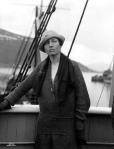

Dervla Murphy looked back on her life of adventure and travel and said that the key to travel is to “embrace the unpredictable.” Murphy certainly did that. She traveled through five continents, some of them with her daughter (when her daughter was 5!). She wrote 27 travel books, and she lived life as she wanted to, not bowing to the modern world.
I loved this book! Dervla’s energy, her love of people, and her resiliency are contagious. She wasn’t afraid to meet people and make friends (although she did carry a pistol with her), staying with provincial governors and wealthy friends, but also the poorest of the poor, in their sometimes flea-ridden hovels, and once in a bed with several dirty children. She would eat the most ghastly, dirty, food with them. She started in January 1963 and traveled through Eastern Europe, Turkey, then Persia (Iran), Afghanistan, and Pakistan, ending up in Delhi, India in November.

 She traveled light, saying “the further you travel the less you find you need.” At one point, she was down to two pens, writing-paper, Blake’s poems (!), map, passport, nylon shirt,” with room for food.
Sorrel had traveled about on bicycle through Japan, Korea, and China for several years, riding a bike up Mt. Fuji and along a stretch of the Great Wall of China near Beijing. She had come to Lhasa in 1984 from China, one of the first people to get a permit from the Chinese. One day while she was in Lhasa, she talked to a man who challenged her; “Now what do you want to do?” he said. “I want to walk across Tibet,” she replied. At the time, she didn’t know what she was getting into.



 If you wanted Alexandra David-Neel to do something, all you had to do was tell her she couldn’t do it. At 5 years old, she ran away from home, scratched a policeman who tried to catch her, and showed no remorse when collected by her father. She was traveling alone in Europe at 17 and she lived independently from that time.
 While in Sikkim (near Tibet, now a part of India) she traveled in the Himalayas and studied with a hermit, sleeping in tents, cooking over a yak dung fire. She said she found that living a life reduced to the essentials pleased her. But she also had a servant with her on her trips, and she took a zinc bathtub everywhere, insisting on a hot bath every night. Oh, well, I guess we are all full of contradictions.
She stayed for several years at a Buddhist monastery called Kumbum, which may have been the place that inspired James Hilton to write Lost Horizon.
If you enjoy travel and adventure, you won’t find much better than My Journey to Tibet. With typical self-promotion, she subtitled it The Classic Story of the Only Western Woman Who Succeeded in Entering the Forbidden City.
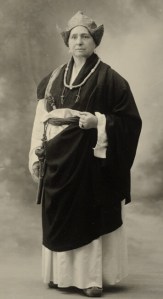 She went back to China in 1937 when she was 69. When the Japanese threatened to invade, she escaped. Her husband Philippe died during this time; she had to wait until after the war to return.
 Sure, she was frightened. She came very close to death multiple times on her trek to Lhasa, from starvation, cold, or being executed for being in Lhasa. She suffered from depression and had many illnesses while she traveled. I read about many other times on her journeys when she could have given up and gone home, but her almost-obsessive need to keep moving, to travel, to live free, kept her going.
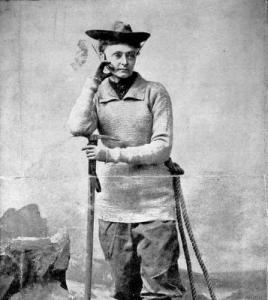 Many women adventurers had it said about them that “she should have been born a boy,” but probably no more so than Annie Smith Peck. Just look at her; she scandalized the socialites in Rhode Island with her climbing attire. Here she models her outfit: wool tunic, knickerbockers (those baggy trousers), puttees (basically support hose), and a felt hat tied with a veil, as she leans on an ice pick.
 Challenges of High Elevation Climbing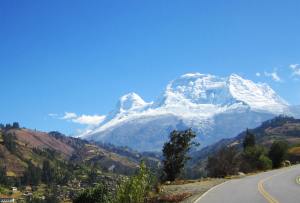
When she returned, her achievements were disputed by other climbers. One of them, Fanny Bullock Workman (you will read about her in another post later) spent $13,000 refuting Annie’s claims. Annie commented that she could have used that money!
I was so moved by Daisy’s obituary in the New York Times that I wanted to find out more. If this story sounds familiar, as it did to me, you might have seen the 2002 Australian movie Rabbit-Foot Fence, which chronicled their journey. I got the book and read it because I don’t trust movie versions of real events.


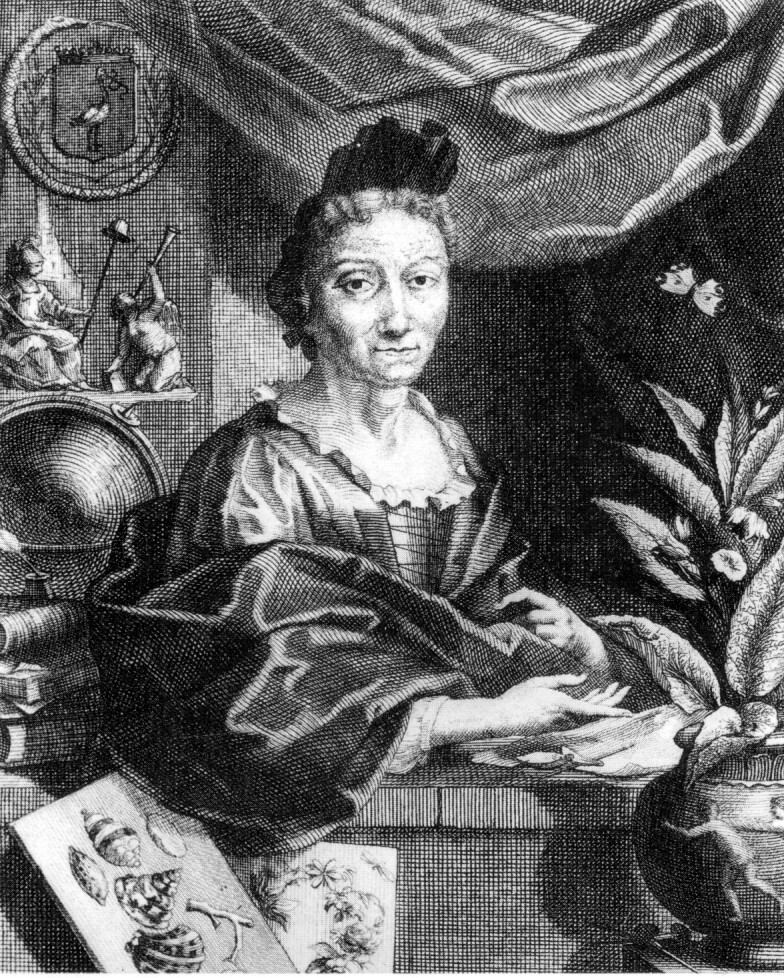 Women in the 1700s didn’t work, they weren’t scientists, and they didn’t travel alone. Maria Sibylla Merian broke through all these barriers, creating a career for herself by combining art and science in a whole new way. Her drive to know sent her (at age 52!) to South America to study in the rainforest. Her life would be extraordinary if she were living today, but it’s even more so in that world.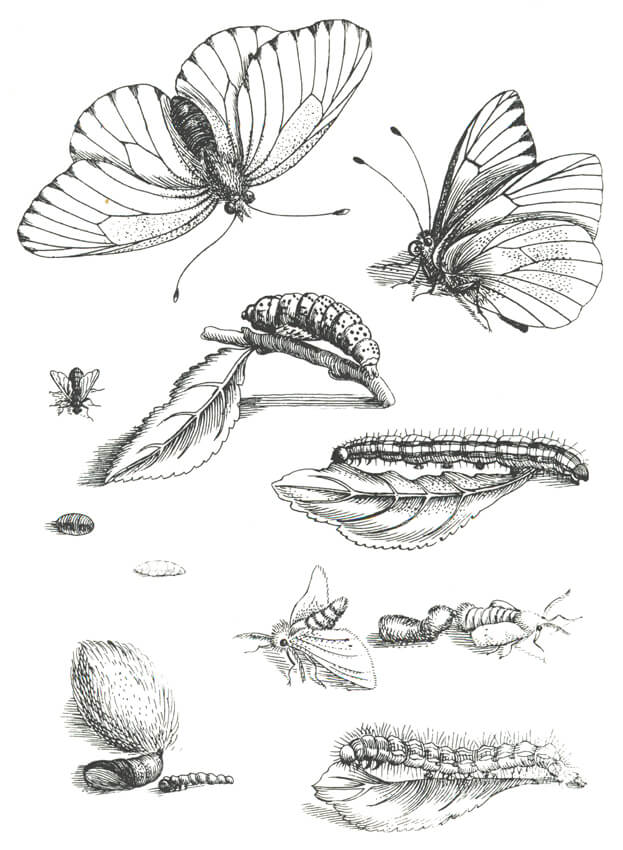
After she returned from Surinam, she spent several years creating what I would consider her masterpiece, Metamorphosis insectorum Surinamensium (Metamorphosis of the Insects of Surinam). The version to the right is a facsimile, in German, and it’s $75.00. Maybe someday someone will publish an English version. I love the prints!
Chrysalis: Maria Sibylla Merian and the Secrets of Metamorphosis


The story of her journey is recounted in Mrs. Adams in Winter, by historian Michael O’Brien. So what happened? Well, just about everything you could imagine. The trip of about 2,000 miles would take about 40 days. They would stop at post stations where they would pick up a postilion (a man who would guide them to the next stop).
The journey began on February 12, 1815, Louisa’s 40th birthday, as they left St. Petersburg in a carriage on runners and a kibitka (a large sled).
Louisa didn’t write about her journey until many years later, in 1836, but it was included in her journals. These personal journals and letters have been turned into a book edited by Margaret Hogan and James Taylor, titled A Traveled First Lady.

By French law, women were not allowed on naval ships, so Baret couldn’t travel as a woman. Glynis Ridley, the author of The Discovery of Jeanne Baret, believes they concocted the story of Baret as Commerson’s “assistant” so they could travel together. They carried this fiction on until she was discovered.
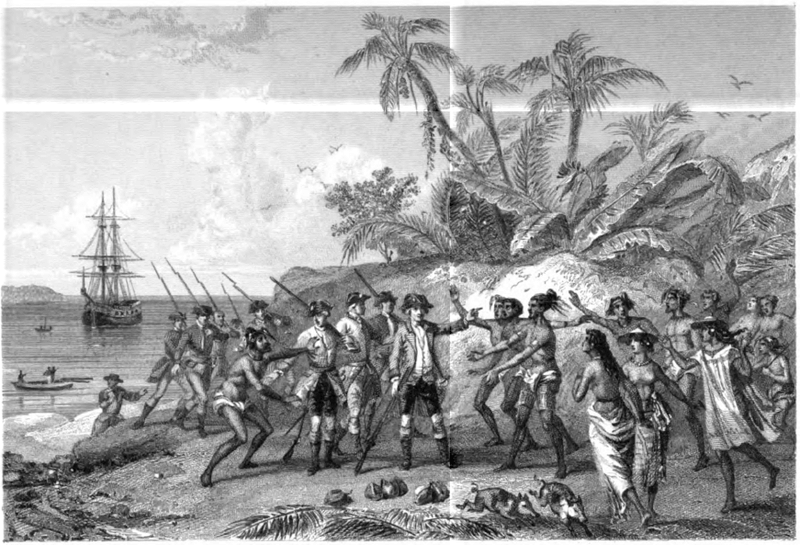
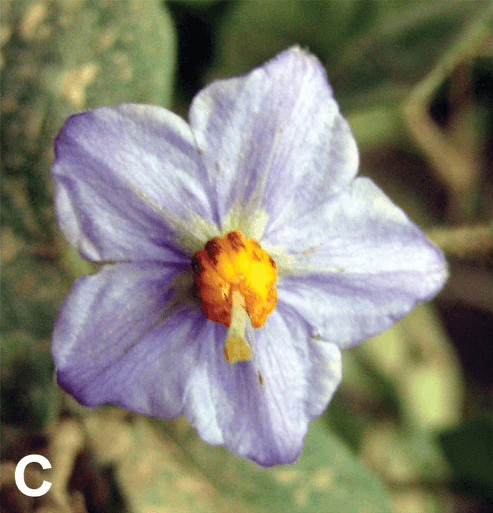


 Dervla Murphy
 I loved this book! Dervla’s energy, her love of people, and her resiliency are contagious. She wasn’t afraid to meet people and make friends (although she did carry a pistol with her), staying with provincial governors and wealthy friends, but also the poorest of the poor, in their sometimes flea-ridden hovels, and once in a bed with several dirty children. She would eat the most ghastly, dirty, food with them. She started in January 1963 and traveled through Eastern Europe, Turkey, then Persia (Iran), Afghanistan, and Pakistan, ending up in Delhi, India in November.

 She stayed for several years at a Buddhist monastery called
 If you enjoy travel and adventure, you won’t find much better than My Journey to Tibet. With typical self-promotion, she subtitled it The Classic Story of the Only Western Woman Who Succeeded in Entering the Forbidden City.
 When she returned, her achievements were disputed by other climbers. One of them, Fanny Bullock Workman (you will read about her in another post later) spent $13,000 refuting Annie’s claims. Annie commented that she could have used that money!


 I was so moved by
 After she returned from Surinam, she spent several years creating what I would consider her masterpiece, Metamorphosis insectorum Surinamensium (Metamorphosis of the Insects of Surinam). The version to the right is a facsimile, in German, and it’s $75.00. Maybe someday someone will publish an English version. I love the prints!

 The story of her journey is recounted in Mrs. Adams in Winter, by historian Michael O’Brien. So what happened? Well, just about everything you could imagine. The trip of about 2,000 miles would take about 40 days. They would stop at post stations where they would pick up a postilion (a man who would guide them to the next stop).
 The journey began on February 12, 1815, Louisa’s 40th birthday, as they left St. Petersburg in a carriage on runners and a kibitka (a large sled).
 Louisa didn’t write about her journey until many years later, in 1836, but it was included in her journals. These personal journals and letters have been turned into a book edited by Margaret Hogan and James Taylor, titled A Traveled First Lady.
 By French law, women were not allowed on naval ships, so Baret couldn’t travel as a woman. Glynis Ridley, the author of The Discovery of Jeanne Baret, believes they concocted the story of Baret as Commerson’s “assistant” so they could travel together. They carried this fiction on until she was discovered.
